
Service Design
In 2019, GS1 Canada launched Agile product squads to increase ROI, streamline operations, and strengthen customer engagement.
Role: UX Lead driving user research and design strategy.
Location: Toronto, Canada
Project: SLM (Subscriber Lifecycle Management) - Onboard, engage and retain net new users and manage business efficiency for existing customers.
Team: 1 agile coach, 1 product manager, 1 UX lead (me), 1 business analyst, 1 scrum-master, 5 developers (3 internal and 2 external), 1 QA tester and 1 journey owner (executive leader/ business sponsorer)
How usability drove user value and measurable internal & external ROI.
$1.5+M
CAD/year, Business revenue generated through UX design lead conversion and cutting back on manual internal process.
15%
reduction, In support calls, improved user satisfaction scores
2X
Increase, monthly lead conversions due from fast onboarding and elimination of cognitive overload in signup processes.
4 MIN
Onboarding, Cut a 20-minute process down to instant activation, replacing a 1 to 7 business day wait.
10K
Net new users, User base grew from 24K (2019–2022) to over 34K within one year of launching the new onboarding in 2022.
KYC
& Sales funnel, Introduced basic KYC for new visitors, enabling more accurate targeting and marketing campaigns.

Phase 1 - Why
The objective was to clarify what we were building and why it mattered. I uncovered the “why” and design values, while the Product Manager defined the product vision. Together, we aligned design and product to secure business buy-in.
Phase 2 - Process
The objective was to define an execution strategy that prioritizes the right level of enhancement and effort avoiding over-design and over-engineering through continuous testing and learning.
The goal is to build a design roadmap that scales current solutions while planning next steps based on deployment impact on product KPIs and business metrics. Success is measured, refined, and iterated through testing.
Phase 3 - The Outcome
Phase 1 - The Why
Rational behind prioritization and how is this a service design?
Service Design:
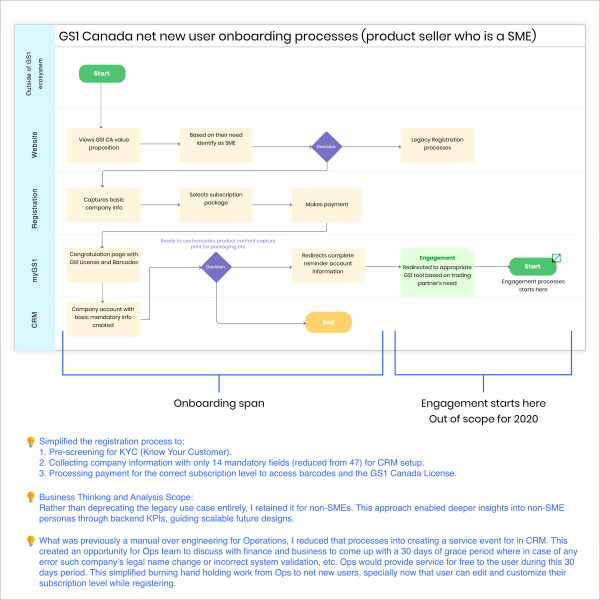
A review of the onboarding SOP showed that meaningful UX improvement required changes beyond the UI. I identified heavy operational effort, complex logistics, technical dependencies, and manual processes that needed revision for design to drive real business value.
Backlog Prioritization:
Partnered with the Product Owner to assess backlog quality and user-story relevance, using insights to challenge assumptions behind the 40K-user goal. Surfaced key pain points and guided a pivot that re-prioritized epics around an evidence-based product vision.
Use the CRM data in context of showing how onboarding/ subscription is high volume and priority for area of focus
CRM business and call log analysis mapping how the current teams managing tickets
According to my hypothesis, the current onboarding processes were preventing the organization from capturing $400K+ CAD in monthly revenue.
Mapped user and business pain points to measurable business costs to drive stakeholder alignment.
Translate data into insights which is based on CRM tickets for operational effort into business cost
Key Insights on Business inefficiency
Validation Delays: Manual processes caused 2-week activation delays, cutting lead conversion by 55-60%.
Operational Strain: Manual CRM entries and executive sign-offs overburdened teams.
Tech Gaps: Lack of automation strained resources and delayed workflows.
Revenue Loss: Payment inefficiencies and external dependencies hurt customer satisfaction and data sync.
My Strategic Thinking
I prioritized context-setting over jumping straight into user-research, helping the business see how internal processes were impacting customer experience. This groundwork later allowed UX methods to scale and demonstrated the strategic value of UX.
Phase 2 - The Processes (UX Research & Analysis)
With clear context and purpose defined, I led the core design process, spanning UX research, analysis, and insight-driven design execution.
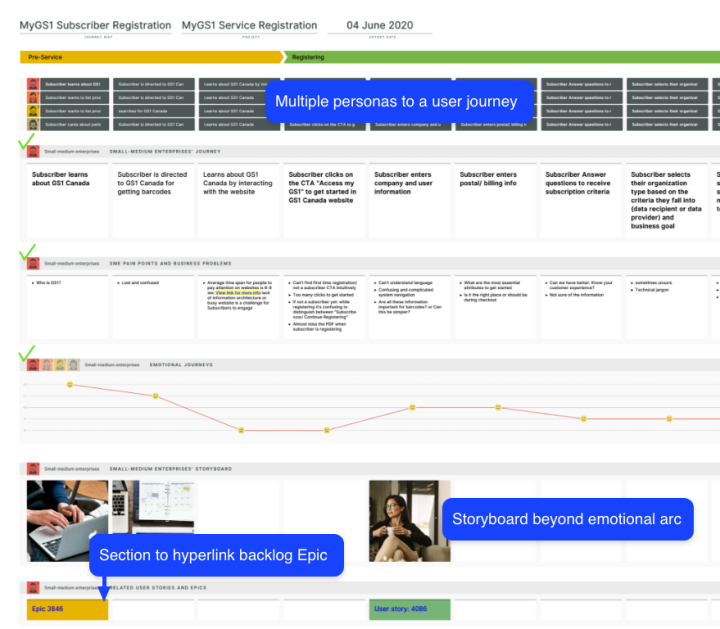
Step 3, Artifact: Document user personas, journeys, and research insights in the project management system and backlog, using scalable templates shared across product, design, and engineering teams.
Step 2 , Show the gap: Empathy mapping revealed how SMEs actually experience the GS1 brand, exposing the gap between internal assumptions and real user perception.
Step 4, Requisite: Personas were designed to be operational, not ornamental. I led workshops to build shared empathy and embedded them into user stories, backlog prioritization, and QA validation.
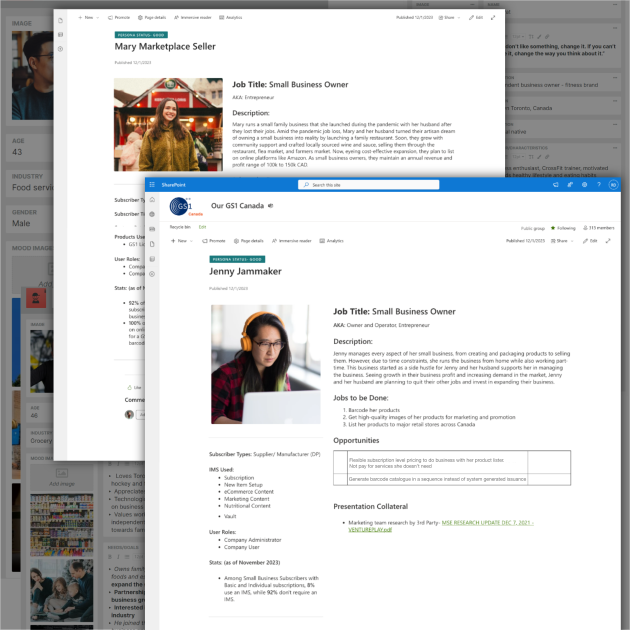
Step 1, Understand: Before presenting research, I facilitated a design workshop where internal teams defined the SME persona themselves. This built alignment through empathy and exposed the gap between assumptions and real user needs
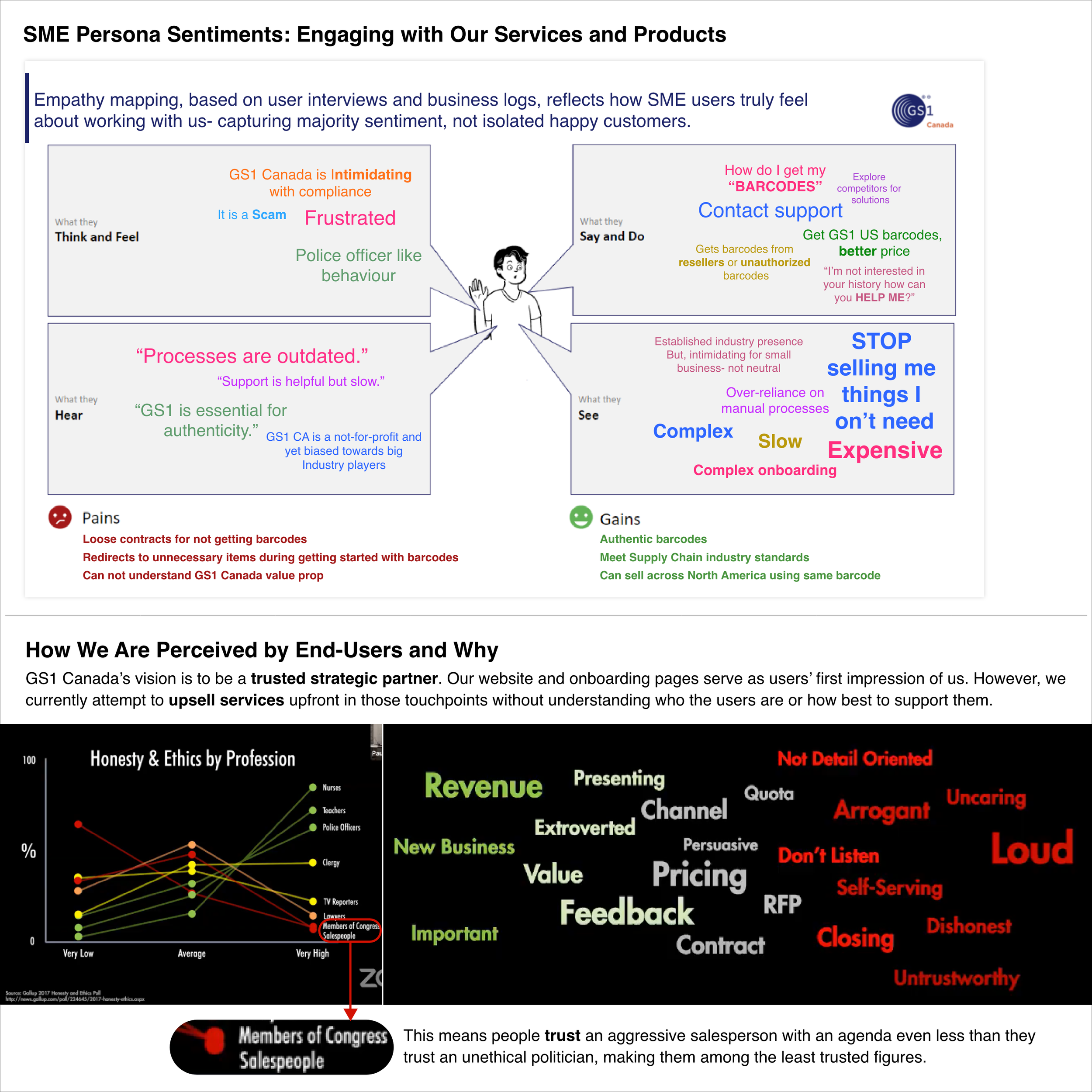
User-journey, Persona & Empathy Workshop Outcomes
• Aligned the business on who an SME is and the values they seek in exchange of giving us business growth (considering them representing the highest user segment of our business.
• Make user interviews and personas being understood and exemplify what does inclusive UX design processes feels like.
• Mapped how users perceive the business to build true empathy with the moment of truth that is irrefutable based on how I communicated and delivered the message through design thinking processes.
• Operationalized a research utilization processes in Azure DevOps as acceptance criteria and embedded them in the shared Product/UX research repository.
Phase 2.1 - The Process (Design & Prototype)
At this stage, my process goal was to translate research into actionable design insights. To do so, I defined a set of custom design guiding principles shaped by business context, user research, and industry-recognized UX heuristics, rather than adopting a standard UX playbook available online.
Design guiding principles → from research to execution
Principle
Language simplification
In-app education
Validation & recovery
System speaking back
Relatable visual experience
What it solved
High cognitive load caused by internal business terminology
Users unsure what they were paying for or what happens next.
Errors, guesswork, and fear of making mistakes
Low trust due to lack of system feedback
Overwhelm in data-heavy workflows
How it showed up in the product
Replaced internal labels with user-intent language (e.g., “Get a barcode” instead of “Become a GS1 subscriber”) to remove friction and unblock task start
Upfront expectation-setting, contextual help text, and tooltips delivered the right information at the right moment without breaking flow
Real-time validation, self-service correction, and pause/resume flows reduced friction while preserving user control
Progress indicators, dynamic fields, clear error reasoning, recommended fixes, and next-step prompts made the system feel responsive
Minimal UI inspired by familiar eCommerce patterns, allowing users to focus on tasks and not learning the interface
Before: Old Onboarding Screens
After: Redesigned Onboarding Screens
Pain points: Cognitive overload caused by complex language, guesswork, and frequent input errors.
Misguided flow: Step 1 expands after Next, obscuring progress and introducing irrelevant questions due to a one-size-fits-all form.
Confusing experience: One-size-fits-all forms surfaced irrelevant questions that weren’t captured in CRM and served only internal validation needs.
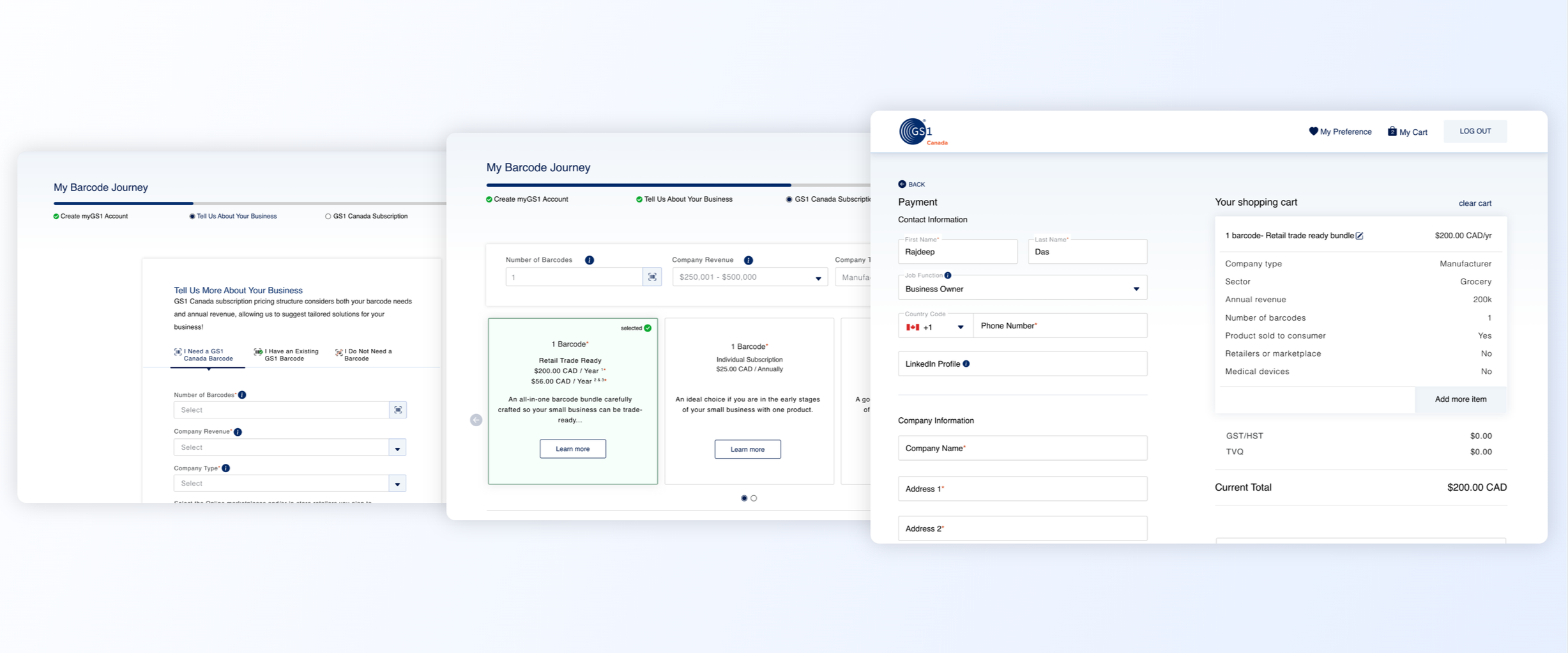
Solution (for testing): Reduced clicks, upfront pricing, and minimal required inputs improved clarity and transparency.
System feedback (real time): The progress bar reflects true progress, and persona-irrelevant fields are removed after user classification.
Relevance & CRM mapping: Industry-specific data is captured and stored in CRM to support downstream services and timely call-centre access.
Phase 2.2 - System Process Improvement
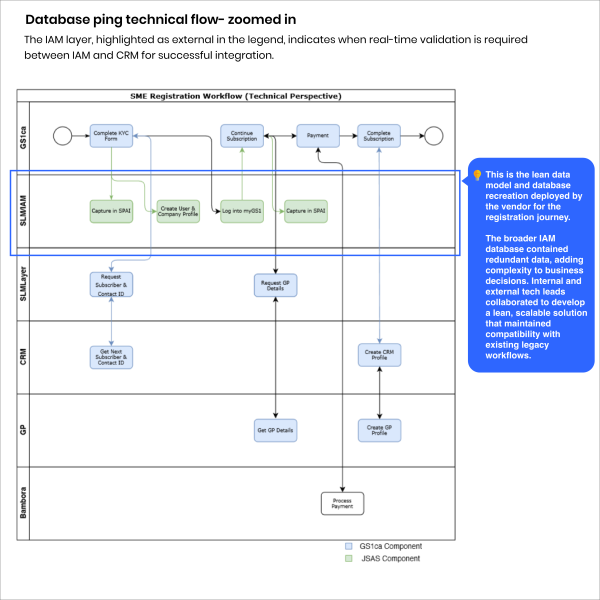
Alongside business process improvements, my service designs work at underlying layer focused on refining the technical flow. Ensuring the usability design operate more efficiently.
Before: Technical map per business flow was made per usecase
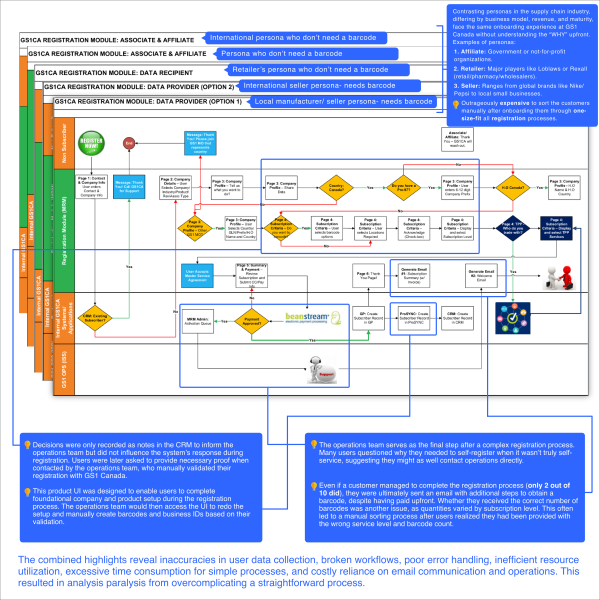
Before: Database ping took time due to lack of integration between IAM and CRM
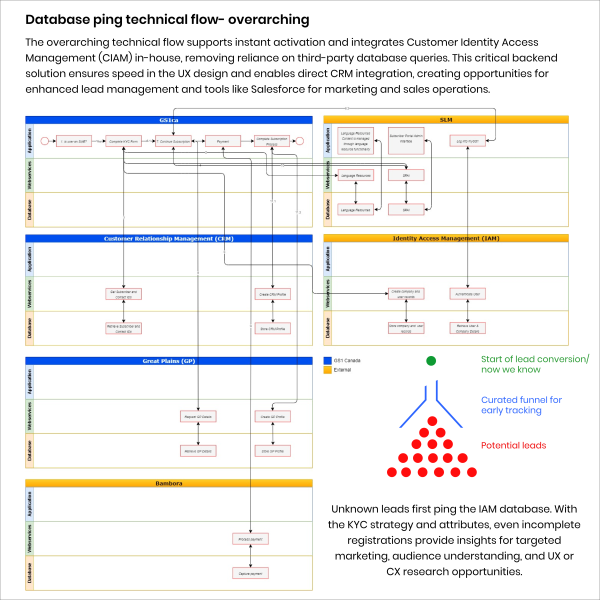
After: Technical map scale one standard flow for all business levels
After: Integrate IAM and CRM system during activation processes reduce manual triage.
Phase 3 - Outcomes (Test prototypes & gauge accuracy of value delivery)
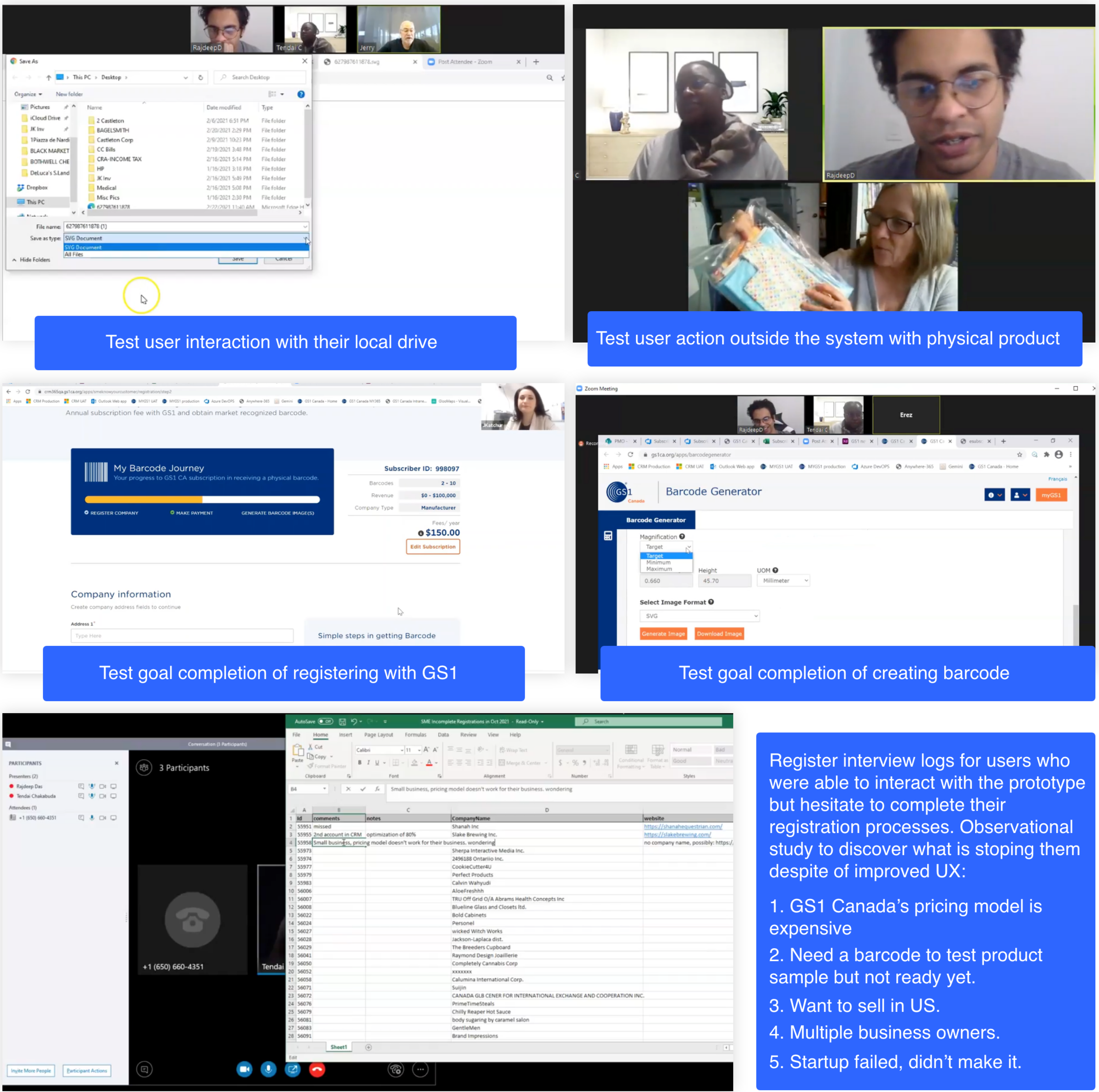
I conducted 15 usability tests using wireframes and prototypes with recent GS1 Canada users, focusing on the task of registering and creating a barcode. Sessions included the product manager, QA, and developers to support Lean UX testing, with insights captured in an interview log. The goal was to iterate and refine the design before development and deployment.
At this stage my objective was to do user interviews to evaluate the speed, accuracy and if the promised values are being delivered to end user. What Insights could I take for design backlog and future iteriation.
Focus area on User Jobs To Be Done
Device usage: 98% of users completed registration on laptops or desktops.
Post-registration actions: Observed real-world next steps, such as retailer outreach and packaging preparation.
Payment & barcode creation: Analyzed behavior during checkout and symbology setup.
Task drop-off: Identified moments of friction and demotivation.
Error handling: Evaluated responses to missing information, edge cases, and technical challenges.
Measure outcomes
Post-deployment, the impact became clear: improved usability drove stronger product KPIs, which translated into measurable business outcomes and customer success.
The metrics highlight business growth in lead conversion and GS1 Canada subscriptions, driven primarily by a Lean, self-serve onboarding redesign that enabled instant access to product barcodes and improved operational efficiency.
Measure outcomes
Internal ROI: I conducted further data analysis with the business intelligence team. I leveraged the metrics program that I used which connected the UX analytics tool (Hotjar and Pendo) with Product KPIs (Power BI) and added insights to what marketing, ops and sales funnel reports was indicating. I showcased how self-service of onboarding contributed to reduced customer call volumes and surfaced qualitative data showing onboarding/ subscription has been consistently requiring least internal resource since the new designs have been launched and subsequently generating the highest revenue (lead conversion and engagement)
What is Next - Design Vision & Roadmap
My goal, based on the design performance of new onboarding and organizational goal to achieve a single platform. I created a design vision of how can we make onboarding a 3 click in and out experience with more accuracy and leading user to this single platform which became part of my portfolio after getting promoted as UX team lead and driving single platform over all design. Note: as UX team lead I was given the role of principle designer, partnering with platform manager to integrate 8 different products of GS1 into a single platform in 2022.
I started on the SLM product team at GS1, and over time expanded to support a broader portfolio while leading the UX team as Practice Lead and building the Design System for Single Platform (into which all products folded) for GS1 Canada.
My onboarding vision focused on reducing clicks and folding the experience into a Single Platform. The concept below demonstrates a 2-step onboarding flow that brings users to the platform homepage in under two minutes, with clear decision paths and minimal error risk.
Given the legacy designs were fragmented and outdated, my long-term approach was gradual modernization by improving usability and brand sophistication without a disruptive visual overhaul, allowing users to focus on experience gains while the business evolved its design standards.